Week 1: Movement
Solo Movements
Shrimping (Hip Escapes)
Shrimping/Hip Escaping is arguable the most important thing you will learn in grappling, it allows you to move efficiently on the ground even when one or more limbs are potentially compromised. Hip movements will be the key to almost all escapes you will encounter.
There are six variations to shrimping, they are broken down into three levels, with increasingly better hip mobilisation as the upper body base point moves down the lever of the arm.
Top Leg
Bottom Leg
Level 1 – Shoulder
Level 2 – Elbow
Level 3 – Hand

Technical Stand Up
Unfortunately standing up isn’t just standing up. The Technical Stand Up is the most efficient way of getting back to your feet while maintaining strong alignment, and minimising potential damage. You will find a lot to cross over with some of the various forms of shrimping, as both involve two base points that allow you to freely mobilise the hips.
Break Falls
These are essential from a safety perspective and must be learned before any stand up work is carried out. These allow you to lessen the impact when being thrown to the ground by spreading the force of impact over a bigger surface area. Various types of rolling break fall will also put your body into the optimal position to safely roll through a throw as well as lessening the for with the limbs.
Week 2: Starting from the Feet
Week 3: Closed Guard
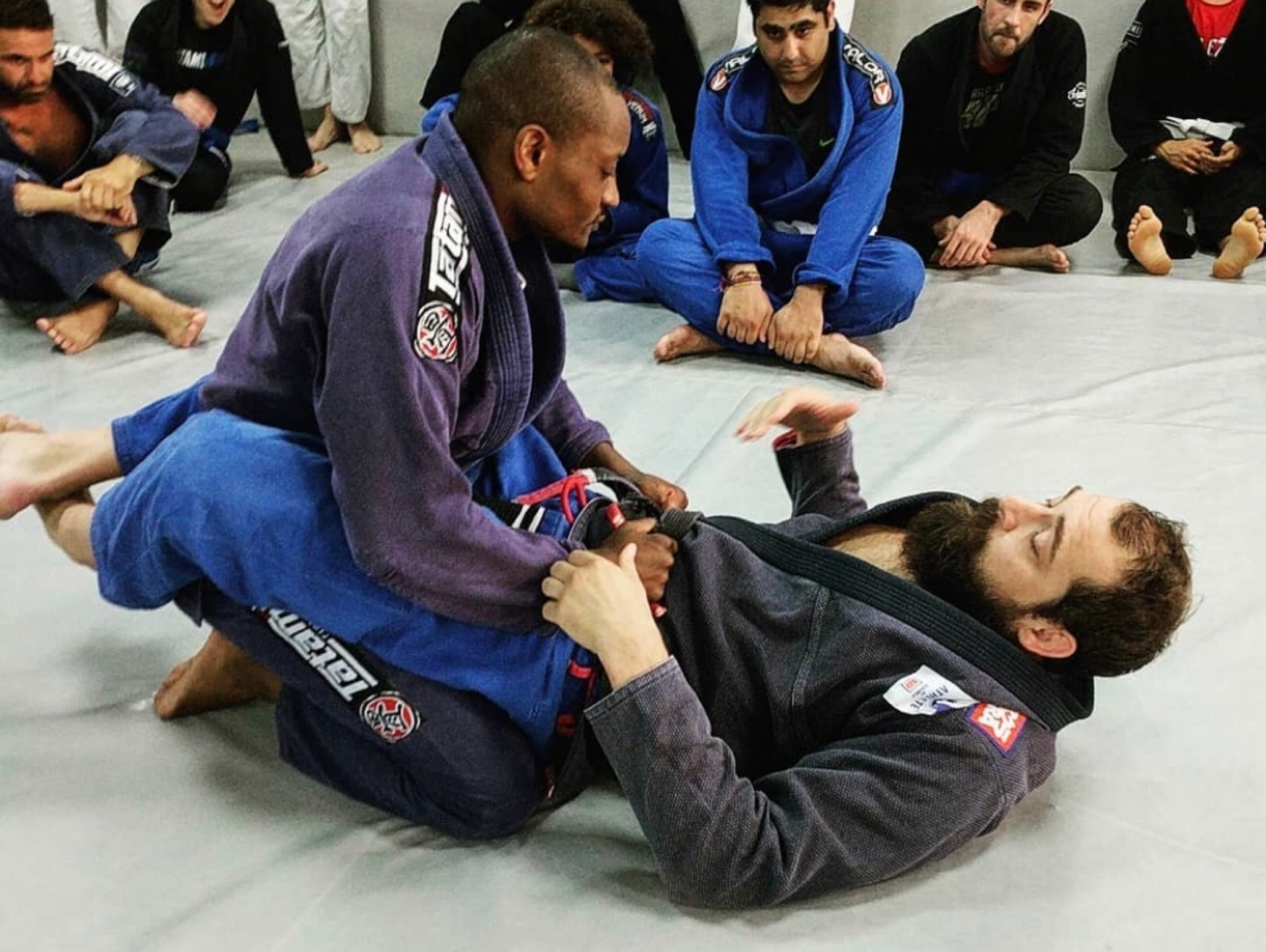
The Closed Guard position in non-striking arts such as Brazilian Jiu Jitsu is seen as a bottom dominant position, in that the Guard Player has numerous avenues of attack, whereas the Top Player must open their opponents feet before they can initiate any real offence.
What is the Guard Players objective?
The Guard Player’s ultimate goals are to sweep to a top position (this is usually Mount from the Closed Guard) or to submit their opponent from the guard position. These are achieved by taking away the alignment of the Top Players and creating off balances in their weight distribution. One of the key battles will be whether the Guard Player can break the posture of their opponent or not.
What is the Top Players objective
There are NO attacks from inside someone’s Closed Guard, so the Top Player’s primary objective is to open their opponents feet in order to create an opportunity to move to a stronger attacking position. Great care must be taken to maintain strong alignment while in your opponents Closed Guard, as breaks in posture and structure will not only make passing more difficult but will put you in danger of submissions and sweeps.
Techniques
- Armbar
- Standing
- Pressure Long Step
- Scissor Sweep to Mount
Week 4: Mount
The Mount is the first of the three Core Positions we will look at. The Top Player has everything in their favour and the Bottom Player is in purely defensive mode. The Mount is regarded as one of the strongest positions in the hierarchy, due to the layers of defence that have been beaten to gain it. It offers easy control due to the ability to significantly compromise the opponents alignment, which in turns creates high percentage submissions.
What is the Top Players objective?
If the Top Player can keep their opponent flat on their back, escaping the Mount position becomes incredibly difficult. If the opponent is able to turn to their side, the Top Player must either return them to a flattened position with their shoulders on the mat or exploit the back exposure and transition to the Back position.
What is the Bottom Players objective?
The key focus is to maintain solid alignment, and optimal limb positioning, this will make it much more difficult for the Top Player to create openings to attack or progress their position. A general rule is to keep your elbows as close to your body as possible to prevent the attacker gaining inside control. Once your defence is solid, progressing to an escape must involve framing the opponents hips and getting onto your side.
Techniques
- Cross Choke
- Control and Maintenance
- Back Take (Harness)
Week 5: Side Control
Side Control is a pinning position in which the Top Player has effectively passed the guard and has control of the hip and shoulder line of their opponent. It is one of the most difficult position to escape, as the Top Player is mobile and able to switch their position in order to nullify escapes.
What is the Top Players objective?
The goal of the Top players in side control is to create an isolation of the limbs or the neck in order to attack a submission. This can be done by using various configurations of Side Control (Modified Scarfhold, North South, Knee-on-Belly etc), all of which create different problems for their opponent, and require different escapes. The second objective is to progress the position to either the Back by creating back exposure or the mount by controlling the hip line.
What is the Bottom Players objective?
The first objective is to defend. Establishing and maintain solid frames is essential, and will allow you to begin the escape process without putting yourself in too much danger. If the Top Players changes his positioning in Side Control it is imperative that you adjust your frames and structure accordingly. There are two general avenues of escape, either establishing an underhook and following it, or Shrimping away to create distance between yours and your opponents hips, and then replacing guard with a lower body frame (knee or foot).
Techniques
- Americana
- Transition to Mount
- Transition to Back (Via Technical Side)
Week 6: Back
The Back is regarded by most as the strongest offensive position in BJJ and most grappling arts. This is validated by the fact that at top level competition, more finishes come from the Back than any other position. With the attacker being behind their opponent, it is virtually impossible to use any form of efficient frame to defend the position.
What is the Top Players objective?
Get a hand in the collar! Once you have an attacking collar grip it becomes significantly harder for your opponent as they will have to defend the attack before escaping. Once you have the back the key to maintaining the position is to never let you opponents head get to the floor, and never let their shoulder line drop below the line of your chest.
What is the Bottom Players objective?
Defend the neck. This is the number one priority when you have an opponent on your back; if you get choked or strangled you will never escape. The arm of your opponent that is over your shoulder (Overhook) must be controlled at all times, as this is the attacking arm. In order to escape the position first you must establish whether your opponent has an underhook or not. If they do, you goal is to get you head to the floor in the side of the underhook. If they don’t, you aim is to slide down, so your shoulder line is level with their hip line.
Techniques
- Double Lapel Choke
- Cradle Strangulation
- Back Escape No Underhook
- Back Escape with Underhook
Week 7: Escapes
Side Control
Both escapes are initiated from a position of strong framing. The Bridge and Shrimp Escape relies on being able to create enough space to move your hips away from your opponent, and this is primarily done with an efficient bridging movement. The Far Side Underhook Escape also relies on the creation of space but this more upper body, and the exploiting of the Inside Control concept
Techniques
- Bridge and Shrimp Escape
- Far Side Underhook Escape
Mount
As with Side Control defending and escaping is heavily frame based. A strong right angle frame across your opponents hips is essential throughout the whole process, and this must mirror the orientation of your opponents even when you have managed to get onto your side. Without effective framing of the hips, your opponent is able to progress to a higher mount, and gain Inside Control with their knees, or transition to the back.
Techniques
1. Elbow Knee Escape
Back
The mechanism for both of these escapes involves using the floor as a barrier to scrape your opponent off your back. Without the ability to use your limbs to frame your opponent, the floor becomes your 5th limb.
Techniques
- No Underhook Escape
- Underhook Escape
Week 8: How to Train and Spar
One of the huge advantages of Brazilian Jiu Jitsu and other grappling arts is that you are able to spar at a relatively high intensity and not risk as much injury as in other Martial Arts. Having said that, emphasis must be on application of correct technique and alignment over that of intensity and power.
You need to be aware of the effective use of sparring and not look at it as a win/lose situation. This is where the whole idea of trying not to have an ego comes into play. Once you realise that
Live sparring gives you the opportunity to learn to apply techniques and concepts to a resisting opponent. At the beginning a lot of what you have learnt and drilled will seem ineffective, this is why sparring is essential for fully developing your skills. Understanding the mechanics of a technique and drilling it on a cooperative training partner is one half of of the learning process, the other half is effectively applying those things in sparring when your partner doesn’t what you to.
Objective of Free Sparring
Objective of Positional Sparring
Core Concepts
Alignment (Biernacki Concept)
- Posture
- This refers to the your spine being in an optimal position. Any deviation in the spinal alignment takes away the potential to generate efficient force. The best example of this is manipulating your opponents head to face away from you in order to minimise the amount of force they can generate in your direction.
- Structure
- This is the positioning of your body, primarily your arms and legs, in order to efficiently operate. Good structure relies more on the skeletal positioning e.g, a straight arm, as apposed to muscular application, e.g. push away and engaging the tricep. Muscles get tired, bones don’t.
- Base
- The a grounded connection that enables you to generate force and to absorb that of your opponents.
Frames
This is an application of structure. It’s using the skeletal structure of the limbs to create an efficient barrier which to absorb and potentially displace your opponents force. Framing is integral to creating strong defence in bad positions, and also creating the space to escape them.
Off-Balancing
The ability to manipulate your opponents weigh distribution, commonly done through the combination of directional forces, e.g push and pull. The success of almost every sweep or takedown/throw will hinge upon your ability to off-balance your opponent. It is the underlying concept that will allow you to create openings and weaknesses in your opponents alignment.
Grip Fighting
Grip fighting or hand fighting is the initial engagement when contact is made. You cannot affect your opponent without having a point of contact on them. Establishing effective grips on your opponent allows you to impose your game, while preventing them doing the same.
Inside Control
Occupying the space between your opponents elbow and their body. It’s most commonly done with your own arms, which is referred to has having an Underhook. When you control the inside space it is incredibly difficult for your opponent to create solid structure and frames with the arms, meaning they have inadequate defences to initiate escapes and the arms are easily isolated to attack.
The Mechanisms of Submissions
- Choke (Neck)
Applying force to the trachea/windpipe in order to restrict the airway and prevent sufficient oxygen getting to the brain.
Example – Back Choke.
- Strangulation (Neck)
Applying force to the carotid arteries in order to restrict blood flow and therefore a sufficient oxygen supply getting to the brain.
Example – Cradle Strangulation or Cross Choke (yes, this has a contradictory name).
- Hyperextension (Joint)
Applying force to a hinge joint (elbow/knee) in the opposite direction to its natural functional range of motion, while restricting the movement of the surrounding joints. In the case of an armbar this would be applying force to the elbow joint while restricting the movement of the wrist and the shoulder. Example – Armbar.
- Rotational (Joint)
Using a lever to create torque in an adjoining lever which ends in a joint, primarily the shoulder or the knee.
– Americana